
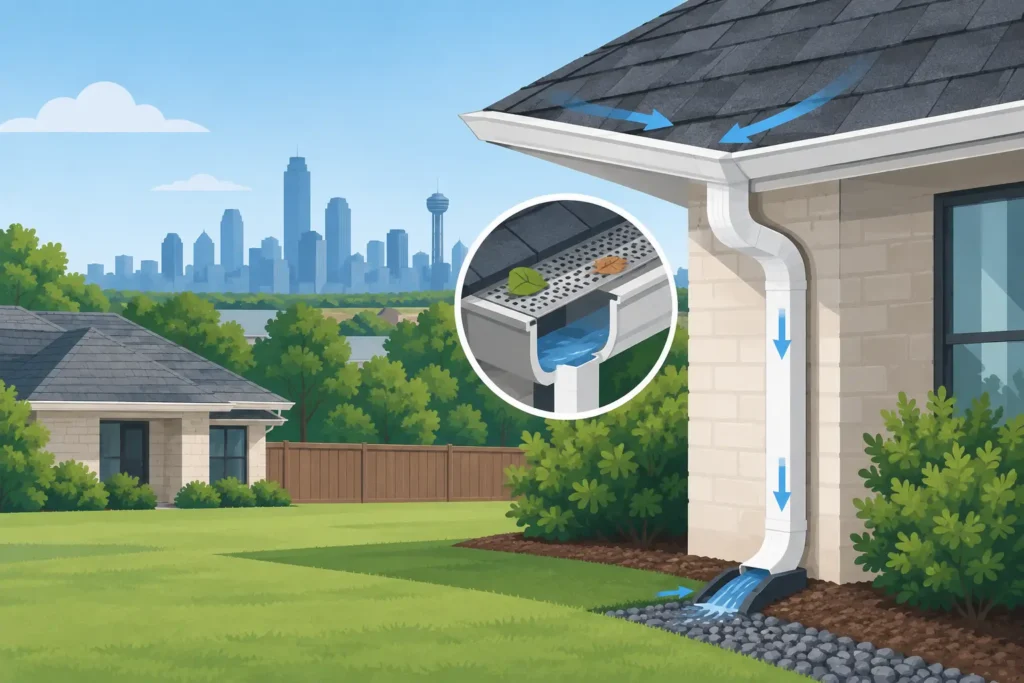
A roof drainage design guide is not just about choosing gutters that look right on the fascia. It is about controlling where thousands of gallons of water go when a North Texas storm moves through. If that water overshoots the gutter, backs up beneath shingles, or pools at the foundation, a small design oversight can become a roof leak, stained brick, damaged landscaping, or costly structural moisture problem.
Your home is an asset. Its drainage system should protect the roof, walls, foundation, and outdoor spaces as one coordinated assembly. The right design depends on roof geometry, surface area, slope, material, tree coverage, local rainfall patterns, and where the property can safely discharge water.
Start With the Roof, Not the Gutter
Homeowners often focus on gutter size first. That matters, but the roof determines the volume and speed of runoff. A simple gable roof sheds water in two predictable directions. A roof with valleys, dormers, intersecting ridges, and low-slope transitions concentrates water at specific locations, creating higher-risk drainage points.
Every valley collects runoff from two roof planes. During a hard rain, that water can move quickly enough to jump a narrow gutter or overwhelm an undersized downspout. A roof-to-wall intersection can also hold debris and direct water against flashing if it is not detailed correctly. These are not cosmetic issues. They are areas where manufacturer-standard roofing installation and drainage planning need to work together.
Roof pitch changes the behavior of water as well. Steeper roofs move water faster. Lower-slope sections move it more slowly, but they can be more vulnerable to standing water when drainage is interrupted. Metal roofing often sheds runoff more rapidly than asphalt shingles, which may require careful attention to gutter placement and splash control.
Calculate Runoff for Real Storm Conditions
North Texas does not receive rain evenly. Long dry stretches can be followed by fast-moving thunderstorms, hail events, and intense downpours. A drainage system that handles a light shower may still fail during the storm that matters most.
A contractor begins by looking at the effective drainage area of each roof section. In practical terms, that means identifying how much roof surface directs water toward each gutter run and where runoff converges. Larger collection areas require more capacity. Valleys, long runs, and roof sections above lower roofs deserve additional attention because they deliver concentrated water rather than a uniform sheet of runoff.
There is no one gutter size that fits every house. A modest roof plane with a short gutter run may perform well with a standard system. A larger home in Heath, Rockwall, Lucas, or Sunnyvale with multiple valleys and broad roof sections may need larger gutters, more downspouts, or both. The best answer is based on the roof itself, not a one-size-fits-all upgrade.
Choose Gutters for Capacity and Control
Gutters need enough depth and width to catch runoff without overflowing. They also need correct slope toward the downspouts. Too little slope lets water stand in the gutter, leaving debris behind and increasing the chance of corrosion, staining, or mosquito activity. Too much slope can look uneven from the ground and may reduce effective capture at one end.
Seamless aluminum gutters are a common residential choice because they are durable, cost-conscious, and available in colors that coordinate with trim. Steel can offer added strength but requires protection against rust. Copper has a distinct appearance and long service life, but it comes at a higher investment level. Material selection should support the home’s architecture and maintenance expectations, not just initial price.
The gutter must also sit in the correct relationship to the roof edge. If it is installed too low or too far from the drip edge, water can pass behind it and saturate fascia boards. If it is placed incorrectly beneath a steep metal roof, fast runoff can overshoot the gutter entirely. Proper drip-edge integration is a small detail with major consequences.
Do not ignore fascia and soffit condition
New gutters cannot correct rotten fascia, failed drip edge, or damaged soffit. Those conditions should be identified before installation, especially on older homes or roofs with a history of overflow. Covering a problem with new metal only delays the repair and can make the damage harder to see.
Place Downspouts Where Water Can Leave Safely
Downspouts are the exit routes for the entire system. A beautiful gutter installation will still fail if there are too few downspouts, if they are undersized, or if they release water beside the foundation.
Placement should follow the roof’s collection points and the property’s grade. Downspouts at the end of long runs are common, but a center outlet or additional outlet may be necessary where water volume is high. Valleys often justify added capacity nearby. The goal is to move water out of the gutter before it can build up and overflow.
At ground level, discharge matters just as much. Water should be directed away from the house onto a stable path that does not send it toward a neighboring property, driveway, or low area near the slab. Extensions, buried drain lines, splash blocks, and graded swales can each be appropriate depending on the lot. Buried lines are clean and effective when designed with proper slope and a clear outlet, but they need maintenance access and should not simply terminate underground next to the foundation.
For homes with heavy clay soil, common across much of North Texas, surface water can linger instead of soaking in quickly. That makes positive drainage away from the foundation especially important. If the yard repeatedly holds water after storms, the solution may involve grading or landscape drainage in addition to roof drainage.
Protect High-Risk Roof Details
A complete roof drainage design guide must account for areas where water is intentionally concentrated. Valleys need properly installed underlayment, flashing practices appropriate to the roofing system, and clean pathways to the gutter. Debris trapped in a valley can force water sideways beneath shingles or toward vulnerable wall intersections.
Chimneys, skylights, pipe penetrations, and roof-to-wall transitions need sound flashing because gutters cannot compensate for weak waterproofing above them. Likewise, crickets behind chimneys help direct water around the obstruction instead of allowing it to pond. On low-slope roof areas, drains and scuppers must remain clear and the membrane system must be designed for the application.
After a hail or windstorm, inspect these locations closely. Lifted shingles, damaged flashing, dented gutters, and displaced downspouts can change drainage behavior immediately. Water damage does not always announce itself with a ceiling stain on the first rainy day. It may begin as damp decking, soft fascia, or a slow leak inside a wall cavity.
Plan for Maintenance Before Problems Start
A drainage system is only as reliable as its ability to stay clear. Leaves, pine needles, roofing granules, and storm debris can block gutter outlets and downspouts. Gutter guards can reduce cleaning frequency, particularly around mature trees, but they are not maintenance-free. Some guard styles handle large leaves well while allowing fine debris to collect on top or inside the gutter.
A practical maintenance routine includes checking gutters in spring and fall, then after major storms. Look for standing water, overflowing sections, loose hangers, peeling paint, stains on siding, eroded soil, and downspouts that discharge too close to the house. From the ground, you can also watch how water behaves during rain. Overflow at a single point often reveals a blockage, poor slope, or an area that needs more capacity.
Avoid walking on the roof or leaning ladders against gutters unless you have the right equipment and experience. A gutter can bend under a ladder, and roof work carries real fall risk. A professional inspection is the better choice when you suspect roof damage, see water stains, or notice drainage changes after a storm.
When Drainage Work Should Be Coordinated With Roofing
The best time to address drip edge, fascia repairs, valley details, and gutter alignment is often during roof replacement. Roofing and gutters are separate systems, but their connection is too important to treat as an afterthought. Coordinating both scopes helps prevent gaps in responsibility and gives the homeowner a clear plan for protecting the entire exterior.
That does not mean every gutter issue requires a new roof. Honest assessment matters. If the roof is sound and the concern is limited to clogged outlets, inadequate downspouts, failing hangers, or poor discharge, targeted drainage work may be the responsible investment. DTM Builds evaluates the roof assembly and exterior conditions together, so homeowners can make decisions based on evidence rather than pressure.
A well-designed drainage system rarely draws attention when it is doing its job. That is the point: when the next heavy North Texas rain arrives, water should move off the roof, through the gutters, away from the home, and out of mind.